Archive for the ‘Research’ Category

Development Communication and Village Self-Dependence

Tuesday, April 12th, 2016

A Case Study on the Usage of ‘Village Portal’ and ‘Village-Partnership System’ to Establish Village Self-Dependence in the Village-to-Develop Movement (Gerakan Desa Membangun) at Banyumas Regency of Central Java Province in 2011-2012

Author: Lisa Lindawati

Abstract

The village development program has so far tended to position village as an object. The Village-to-Develop Movement (Gerakan Desa Membangun/GDM) strengthens village to become the subject of development. Being a subject, village will be self-dependence. One of the strategies in establishing the village self-dependence is using new media. This study reviewed how the development communication creates the village self-dependence by utilizing new media such as Village Partnership System (Sistem Mitra Desa) and ‘Village Portal’  in the Village-to-Develop Movement (Gerakan Desa Membangun). By virtue of a study case method, this study tried to describe clearly the contemporary, unique phenomenon taking place in this movement. After a series of studies, it was found out that  Development Communication of this movement used the technology relevant to the focus of development and the requirement of villagers. Also, this movement considered participatory communication in promoting the community participation and capacity. With the synergy between proper technology and participatory communication, the village obtained its self-dependence as shown by the fulfillment of community requirements, the empowerment of local institution, and the village participation as the main actor in the development process. Additionally, the process of technology utilization has opened a room for social learning by taking into account the local potential and knowledge, which was then communicated to the public. It means that village can communicate itself. The findings showed that development communication by using new media in accordance with the village requirements, along with the existence of participatory communication, can create village self-dependence.


For full article please contact us or click this link

Pola Akses Berita Online Kaum Muda

Thursday, November 26th, 2015

Author: Lisa Lindawati

Abstrak

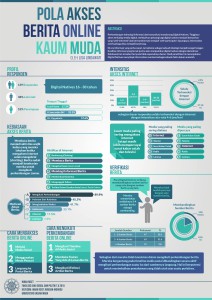
Perkembangan teknologi informasi dan komunikasi mendorong lahirnya generasi digital atau Digital Natives. Generasi ini tumbuh dalam era informasi yang berlimpah ruah (information overload). Mereka mempunyai akses yang lebih tinggi terhadap media digital dibandingkan dengan generasi sebelumnya (Digital Immigrants). Hal ini melebarkan peluang bagi digital natives menjadi komunitas yang ‘well-informed’ dan bertransformasi menjadi ‘well-participate’. Sayangnya, information overload juga bisa menjadi bumerang. Di era informasi yang serba cepat, Jurnalisme sebagai sebuah ideologi menjadi sangat longgar. Alih-alih membentuk kaum muda yang ‘well informed’ dan ‘well participate’, kualitas informasi, dalam hal ini berita, yang buruk justru akan merentangkan jarak digital natives dengan kehidupan berdemokrasi. Kekhawatiran tersebut ternyata tidak sepenuhnya benar.  Hasil penelitian ini menunjukkan Digital Natives menyikapi information overload sebagai sebuah fakta bukan masalah. Digital Natives menempatkan internet sebagai sumber berita utama. Hanya saja, internet belum mendapat kepercayaan penuh dari kaum muda. Surat Kabar dan Televisi masih menjadi media yang lebih dipercaya dibanding internet. Meskipun demikian, membaca berita sudah menjadi keseharian untuk mengikuti perkembangan. Motif ini terlihat dari kebiasaan mereka mengikuti timeline media sosial. Digital Natives juga terbiasa membandingkan berbagai sumber berita. Hanya saja, sebagian dari mereka tidak konsisten dalam mengikuti perkembangan berita. Mereka bergantung pada timeline media sosial. Hal ini berpotensi untuk menimbulkan pemahaman yang tidak utuh atas suatu peristiwa. Disamping itu, kecepatan yang selama ini didewakan oleh para jurnalis online ternyata bukan karakter terpenting yang dibutuhkan. Kejelasan berita menjadi prioritas utama. Menariknya, disamping membutuhkan berita yang jelas dan ringkas, kaum muda juga menginginkan berita online yang mendalam. Hal ini menjadi pekerjaan rumah bagi institusi media untuk memperbaiki produknya.

For further data please download link below

Pola Akses Berita Online Kaum Muda

Poster_Riset-PABOKM

THE LOCAL MEDIA AND POVERTY

Thursday, February 26th, 2015

Qualitative Content Analysis, Trend of News Poverty in Yogyakarta by Local Media Online ‘Kedaulatan Rakyat’ and ‘Tribun Jogja’

Author : Lisa Lindawati

Abstract

The media are important actors in building public discourse. Its strength as an agenda setter is able to direct attend the public, including the policy makers. The media seemed to be a selector for the various elements to determine which issues are crucial and which are not. With this power the media has a strategic role in mainstreaming various crucial subjects that require immediate action. One of them is poverty. Poverty remains a major agenda in this country. Unfortunately, the role of the media in this issue is not yet optimal. It was shown in a study conducted in the local media in Daerah Istimewa Yogyakarta, which incidentally is a poor region in Indonesia.

First, the issue of poverty is expected to become the mainstream has not been able to for reviews sharply from the local media. It is seen from the low level and consistency coverage preaching. Local media tend to focus on events, not on issues that require digging deeper. Second, poverty reports in local media online still tend to rely on formal sources and provide minimal space for the voice of the grassroots. Consequently preaching poverty tend to examine the problem from one side (one-sided). This is contrary to the spirit that carried cover both-side in journalism itself. Method of delivery is an indicator neutral objectivity. Unfortunately, neutrality makes news, in the local online media, poor interpretation. This is related to the third conclusion, that the media have not been sensitive in capturing the issue of poverty. Poverty is still seen as dealing with charities that contrast with the spirit of empowerment that should be the spirit of the current development. In addition, the media also have not been able to define the root causes of poverty firmly. Interestingly, more daring media define an appropriate solution to poverty reduction.

We need to think about the future of the media regarding their role in poverty alleviation. The results of this study are expected a picture of extending the relationship and the beginning of the media’s role in these issues. Hope for the future, various stakeholders should strive to enable the media as an accelerator of development, especially poverty reduction. It takes a special association to discuss the issue. Followed by a variety of training and work for poverty-prone areas. If necessary, the model may be initiated an award for journalists able to preach poverty well. Thus journalists superior to understand the issue and proclaim correctly. Furthermore is to produce news that affects the handling of poverty itself.

For further information about this research please contact me

Kecenderungan Konten Berita Jurnalisme Warga dalam Portal Desa ‘Gerakan Desa Membangun’

Saturday, December 27th, 2014

Author: Lisa Lindawati


Abstract

The existence of new media blurs the dichotomy between media and audiences. Production of information is no longer monopolized by the mainstream media. It is challenging and convey a significant impact on journalism. New media fertilize what is called the Citizen Journalism. Production of information is no longer controlled by the ‘educated’ and ‘modern’ communities. This condition allows the grassroots community get a chance to speak up. One is a village in the ‘Gerakan Desa Membangun’ networks . By Using Village Portal, the Village has been turned into productive producers of information. Their motive is to present a counter representation of the Village. In this context , the tendency of news content into a fascinating study. By using the qualitative content analysis, the results of this study indicate there is optimism that want presented through new media. Portal Village presents the viewpoint of ‘ordinary people’. Villagers got a dominant place. This shows the strength of the village as community that wants to exist , that they are there , they are Voiced , and they are empowered.


Diterbitkan dalam Jurnal IPTEK-KOM (Jurnal Komunikasi, Informatika, dan Kebijakan)
Volume 16 No.2 Desember 2014 hal. 133-150
ISSN 1410-3346
Terakreditas LIPI No 468/AU2/P2MI-LIPI/08/2012

For full paper please download link below

Kecenderungan Jurnalisme Warga

‘MENGERASKAN’ SUARA DESA

Saturday, December 20th, 2014

Studi Kasus Peran Media Lokal Online dalam Mengarusutamakan Wacana Desa sebagai Komunitas Mandiri di wilayah Kabupaten Banyumas Jawa Tengah pada tahun 2013-2014

Author: Lisa Lindawati, Rezha Rosita Amalia, Rani Eva Dewi

Perkembangan teknologi informasi dan komunikasi (TIK) menjadikan informasi dan komunikasi sebagai elemen penting penggerak masyarakat. Disamping itu, perkembangan TIK menggeser otoritas media sebagai produsen tunggal informasi dalam ruang publik. Hal ini memberikan peluang bagi komunitas masyarakat rentan, dalam konteks ini adalah masyarakat desa, untuk melakukan percepatan pembangunan. Salah satu strateginya adalah dengan mempunyai akses dan kemampuan produksi serta kontrol informasi untuk membangun representasi dan komunikasi yang tepat dengan berbagai stakeholder. Hanya saja bukan berarti menanggalkan peran media arus utama sebagai pembangun wacana. Yang perlu dilakukan adalah menemukan model sinergitas antara kekuatan media komunitas dan media arus utama dengan optimalisasi pemanfaatan TIK dalam mendorong Kemandirian Komunitas Desa. Setelah sebelumnya melakukan penelitian terkait dengan kekuatan media komunitas, peneliti ingin menggali kekuatan media arus utama dalam mendorong kemandirian masyarakat. Targetnya adalah memetakan peran media arus utama, lebih spesifik adalah media lokal online, dalam mengarusutamakan informasi Desa.

Untuk mencapai tujuan tersebut, peneliti menggunakan metode studi kasus. Metode ini memberikan fleksibilitas peneliti untuk mengumpulkan data dengan menggunakan variasi metode pengumpulan. Selain itu, metode ini mampu mengejar kedalaman dan keunikan suatu fenomena untuk kemudian direfleksikan dalam konteks yang lebih luas. Peneliti mengambil kasus di wilayah Kabupaten Banyumas dengan pertimbangan perkembangan media komunitas dan media lokal yang sangat dinamis. Lebih spesifik, peneliti memilih dua harian online terkemuka di wilayah tersebut, yaitu Radar Banyumas (www.radarbanyumas.co.id), dan Satelit Post (www.satelitnews.co).

Dari hasil penelitian, peran media arus utama dalam menguatkan wacana Desa belum dapat dikatakan signifikan. Pasalnya, konsistensi atas isu Desa masih sangat minim. Dari sudut pandang media arus utama, terutama media lokal, Desa memang sudah selayaknya mendapat koverasi yang dominan. Hanya saja sumber daya liputan dan keluasan wilayah Desa tidak berimbang. Disamping itu, belum ada kebijakan redaksional yang secara eksplisit memprioritas isu penting Desa. Hal ini menyebabkan pemberitaan mengenai Desa terlihat tidak konsisten dan tidak terkonsep. Belum ada pembingkaian yang tegas dalam mewacanakan isu Desa.

Selain belum konsisten, isu yang dikembangkan dalam media arus utama lebih banyak yang bernada negatif dibandingkan dengan positif. Desa lebih banyak ditempatkan sebagai objek dari berbagai program pembangunan alih-alih ditempatkan sebagai subjek yang aktif mengembangkan dirinya sendiri. Hal ini juga dapat dilihat dari pemilihan narasumber dimana komunitas Desa tidak diberikan tempat yang strategis. Suara pemerintah Daerah masih menjadi primadona yang menjadi dasar pembingkaian media. Dalam konteks ini, pemahaman mengenai nilai berita dianggap menjadi penyebab perbedaan persepsi antara jurnalis profesional dengan warga Desa ataupun Jurnalis Warga. Sehingga, isu yang dianggap penting oleh Desa belum tentu dilihat sebagai isu yang bernilai berita. Pemahaman inilah yang harus dilihat secara serius dalam menemukan model sinergi yang tepat.

Media lokal mengakui lemahnya peran mereka dalam mengatusutamakan wacana Desa. Berita baiknya, mereka mempunyai iktikad baik untuk meningkatkan perannya dalam memberdayakan komunitas Desa. Terlebih dengan disahkannya UU Desa No 6 tahun 2014, dimana Desa diberikan otoritas yang lebih besar dalam mengelola pembangunannya. Perlu ada sinergi antara jurnalis media lokal dengan para jurnalis warga ataupun masyarakat Desa pada umumnya. Salah satu langkah konkrit yang dapat dilakukan adalah dengan menginisiasi sebuah forum yang mempertemukan dua elemen tersebut. Dengan demikian, media tidak lagi memarginalkan suara Desa tetapi justru membantu mengeraskan suara Desa.

For further information about this research please contact us
Village Voiced, Village Empowered

Wednesday, December 17th, 2014

A Case Study of the Citizen Journalism Practice Using New Media as a Medium of Empowering the Villagers at Banyumas Regency in 2012-2013

Author: Lisa Lindawati


Abstract

Village is basis of the poor in Indonesia. This condition has placed Village as the main target of the poverty-eradicating program. Unfortunately, the development program that has been implemented in Village is ineffective. So far, Village is viewed more as passive object with limited authority to manage itself independently. The condition above encourages a group of community at Banyumas Regency to initiate a movement called Gerakan Desa Membangun (Village-to-Develop Movement). By the utilization of Information and Communication Technology, the Movement encourages Village to develop various kinds of the internet-based media. One of the new media developed is Village Portal (Village Website). This portal gives room to inform any potentials and activities of the Village through cyber world. It is here that the Village practices Citizen Journalism.

This study was a case study to reveal how new media, as new medium in the Citizen Journalism practice, become powerful weapon to reinforce the Village’s representation in the discourse competition at the public sphere. The ultimate result is the increasing bargain position of the Village before various stakeholders. The finding showed that the democratization of information and communication media becomes the key factor in establishing an empowered community. By taking hold of such media, they are able to control the information. With this power, they become a community with high bargain power before the stakeholders.


For further information about this research please contact me

Development Communication and Village Self-Dependence

Thursday, December 26th, 2013

A Case Study on the Usage of ‘Village Portal’ and ‘Village-Partnership System’ to Establish Village Self-Dependence in the Village-to-Develop Movement (Gerakan Desa Membangun) at Banyumas Regency of Central Java Province in 2011-2012

Abstract

The village development program has so far tended to position village as an object. The Village-to-Develop Movement (Gerakan Desa Membangun/GDM) strengthens village to become the subject of development. Being a subject, village will be self-dependence. One of the strategies in establishing the village self-dependence is using new media. This study reviewed how the development communication creates the village self-dependence by utilizing new media such as Village Partnership System (Sistem Mitra Desa) and ‘Village Portal’  in the Village-to-Develop Movement (Gerakan Desa Membangun). By virtue of a study case method, this study tried to describe clearly the contemporary, unique phenomenon taking place in this movement.

A big question arises in this research is how development communication creates the village self-dependence by utilizing ‘Village Portal’ and Village Partnership System in the Village-to-Develop Movement (Gerakan Desa Membangun) at Banyumas Regency. The Village-to-Develop Movement (Gerakan Desa Membangun/GDM) is a common initiative involving multi-parties for a purpose of strengthening the capacity of village management and the competency of villagers to establish development initiative. The GDM has also a purpose of establishing village cooperation and relationship for a mutual support in the village development. This movement emerged as a criticism against the practice of village development tending to be top-down rather than bottom up. Village has so far been the object of development rather than being the subject. The Village-to-Develop Movement intends to demonstrate that village is able to be the subject of development.

In achieving such purpose, the Village-to-Develop Movement utilizes Information and Communication technology, particularly new media. This movement has chosen to use an ‘open source’ technology as the basis of developing various applications. The BlankOn Operation System becomes the used choice. It also develops the Village Partnership System to promote the population data at village and ‘Village Portal’ as the channel of any village information to the outside world.

From the general results of this study, it can be seen how development communication has created the village self-dependence. In view of the self-dependence principle, technology is positioned as an enabler controlled by the users, not vice versa. By considering the self-dependence principle, communication runs in a participatory way. Supported by the improving spirit of village autonomy, as a strategy, practice and use of technology, development communication can produce village-self dependence.

The results achieved by the Village-to-Develop Movement are an evidence of village capacity in developing good governance and managing information. By the good governance, information can be continually produced, distributed and managed to improve the village bargaining power before any stakeholders. This indicates a great opportunity to render more power to the village. The local governing policy is properly required to legalize this movement. Village is an autonomous entity having the power to develop itself. It is proper that the village government renders more authority to the village to develop itself.


For further information about this research please contact me